Best Time to Visit Antelope Canyon
The best time to visit Antelope Canyon is shaped by light behavior, seasonal weather, and how different canyon layouts affect crowd flow. This guide explains when and why Upper, Lower, and Antelope Canyon X feel most rewarding — beyond simple "peak season" advice.
How Light Changes Throughout the Day
Antelope Canyon light is not “bright vs dark.” It changes in angle, contrast, and color temperature as the sun moves—shaping what you see and how the canyon feels minute by minute.
Think of the canyon as a natural light instrument. As the sun rises, climbs, and drops, the entry angle and reflection path change. In narrow sections, small shifts in angle can switch the scene from soft gradients to high-contrast bands of light.
This is why two tours on the same day can feel completely different—even with similar weather. What most visitors call “best light” is usually a mix of three things: directional light (clear edges), reflected glow (warm walls), and manageable contrast (details not lost to shadow or glare).
- Angle: controls whether light reaches deep sections or stays near the top
- Contrast: affects texture visibility and photo dynamic range
- Color: shifts from cooler tones to warmer reflected sandstone glow
Note: Cloud cover can reduce harsh contrast and improve wall color, but it can also remove dramatic highlights. Weather changes “quality,” not just “brightness.”
Morning Light
Softer contrast and cooler tones. Wall textures read cleanly, and shadows feel deeper. Great for a calm, sculptural look—less “spotlight,” more “shape.”
Midday Light
The sun is higher, so light can penetrate more directly in certain openings. Expect stronger highlight–shadow separation and the most “dramatic” moments when conditions align.
Afternoon Light
Light becomes more directional again, often creating richer warm reflections. Contrast can ease compared to peak midday, and compositions feel more “glow-focused.”
Seasonal Light Patterns: What Changes Month by Month
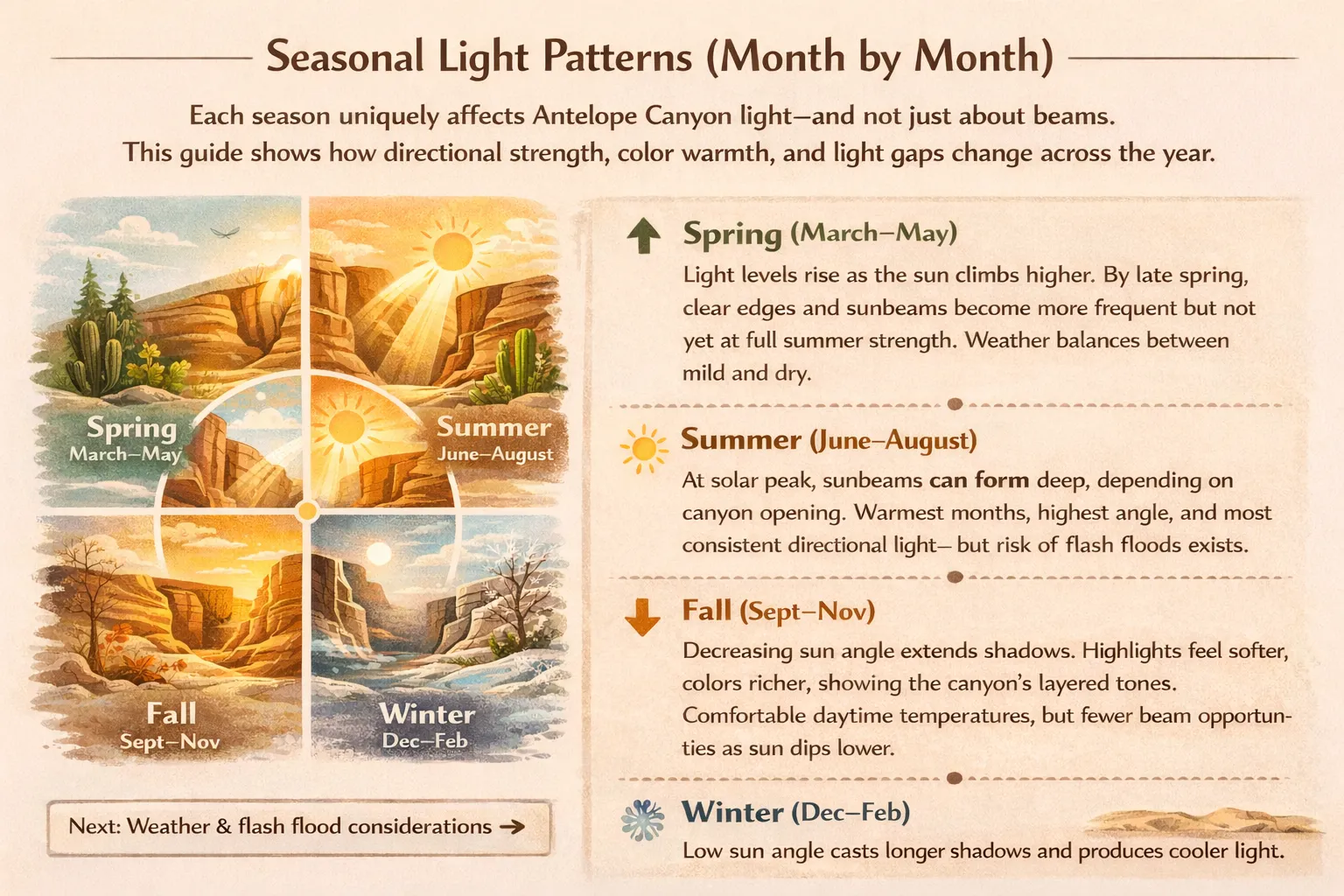
Light inside Antelope Canyon changes with sun angle and season, shaping contrast, color, and overall atmosphere.
Spring
Balanced light with gentle contrast. Reflected glow becomes more visible as the sun rises higher, without the intensity of peak summer.
Summer
Highest sun angles of the year. Upper Canyon has the strongest beam potential, while weather variability plays a larger role.
Fall
Softer highlights and deeper color gradients. Light feels calmer and less directional across all canyons.
Winter
Mostly indirect light and longer shadows. Beams are rare, but the canyon atmosphere feels quiet and immersive.
Weather & Flash Flood Season
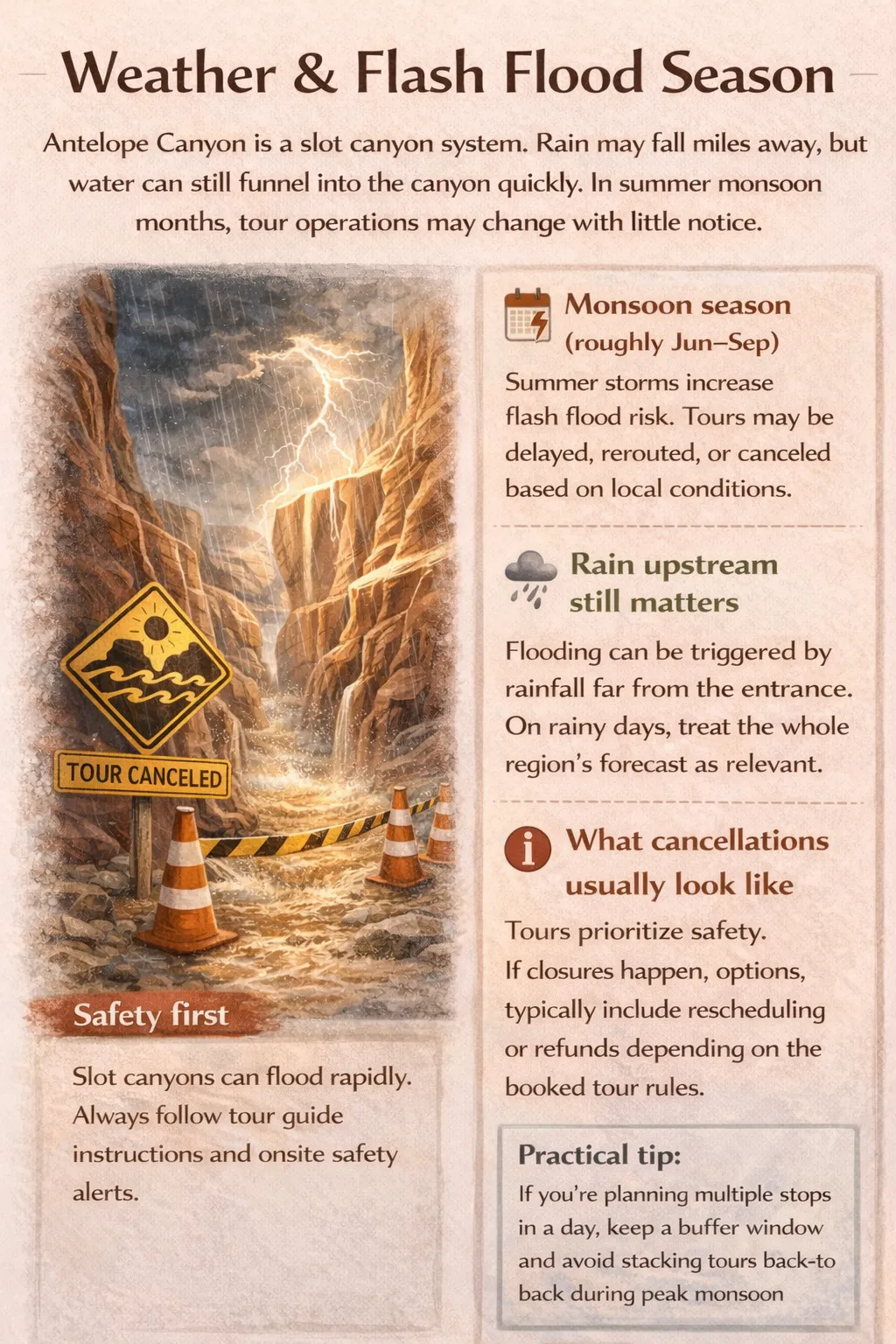
Antelope Canyon is a slot canyon system. Rain may fall miles away, but water can still funnel into the canyon quickly. In summer monsoon months, tour operations may change with little notice.
Monsoon season (roughly Jun–Sep)
Summer storms increase flash flood risk. Tours may be delayed, rerouted, or canceled based on local conditions.
Rain upstream still matters
Flooding can be triggered by rainfall far from the entrance. On rainy days, treat the whole region’s forecast as relevant.
What cancellations usually look like
Tours prioritize safety. If closures happen, options typically include rescheduling or refunds depending on the booked tour rules.
Best Time of Day: Light, Crowds, and Tour Flow
In a slot canyon, “best time” depends on what you want to feel and capture—beam intensity, softness of reflected light, and how fast groups move through tight sections.
Early Morning (First entries)
The calmest pace. Cooler air, quieter moments, and softer light—great for texture, curves, and clean compositions before the day builds.
- Best for: Low-crowd feel, warm textures, handheld shooting
- Expect: Less direct sun, more even tones
Late Morning
Light starts to “shape” the canyon more clearly. Shadows deepen, contrast increases, and the overall look becomes more dramatic—without being all about beams.
- Best for: Balanced light + manageable flow
- Expect: More contrast, more frequent photo pauses
Midday (Beam window in Upper)
This is the “beam” period people think of—most relevant to Upper Canyon and highly dependent on season and clear skies. Timing matters more than the calendar alone.
- Best for: Upper Canyon beams, high drama
- Expect: Peak demand and structured movement
Late Afternoon
Light softens again. Colors can look richer and less harsh, and the visit often feels more relaxed—especially for travelers prioritizing atmosphere over “must-hit” shots.
- Best for: Color gradients, relaxed pacing
- Expect: Fewer beam moments, more ambient glow
Crowds, Capacity, and When the Canyons Feel Most Relaxed
Crowd experience at Antelope Canyon is shaped less by total visitor numbers and more by timing, route design, and how tours are staggered.
Peak Season (Late Mar – Oct)
This is when demand is highest, especially around midday. Tours are tightly scheduled, movement is structured, and photo stops are shorter—yet flow is generally controlled rather than chaotic.
- Feels like: Efficient, guided, time-aware
- Best strategy: Early morning or last slots
Shoulder Season (Mar & Nov)
Often the most balanced period. Visitor numbers are moderate, guides can slow the pace slightly, and lighting conditions remain strong without peak-season pressure.
- Feels like: Noticeably calmer, more flexible
- Best for: First-time visitors wanting balance
Winter (Dec – Feb)
The quietest time of year. Groups are smaller and pacing is slower, though daylight hours are shorter and beam visibility is limited.
- Feels like: Unhurried and intimate
- Trade-off: Softer light, fewer dramatic contrasts
Photography Timing Considerations
Choosing the right time for photography in Antelope Canyon is less about gear and more about how light, movement, and crowd flow interact at different hours.
Midday: Controlled Highlights
Around midday, sunlight enters the canyon from higher angles. In Upper Antelope Canyon, this creates direct light beams; in Lower and Canyon X, it produces strong contrast between illuminated walls and shadowed corridors. This window favors dramatic highlights and clearly defined compositions.
Morning: Softer Transitions
Early tours tend to emphasize reflected light rather than direct illumination. Colors appear smoother, shadows are longer, and textures feel more continuous. This timing works well for photographers who prefer subtle gradients and a calmer visual rhythm.
Afternoon: Movement & Depth
As the sun lowers, light shifts rapidly along canyon walls. This creates changing perspectives as you move, especially in Lower Canyon and Canyon X. Afternoon sessions reward photographers who react to evolving angles rather than waiting for a single “perfect” moment.
Common Timing Myths
Antelope Canyon timing advice is often oversimplified. Here are a few common myths—and what’s actually true in practice.
Myth: “Midday is always the best.”
Midday can be ideal for dramatic highlights, but it also brings stronger contrast and a more “on-rails” feel. If you prefer softer tones and calmer pacing, earlier hours can be more rewarding.
Myth: “No beams = not photogenic.”
Light beams are only one look. Many of the most compelling images come from reflected light, color gradients, and shadow shapes—especially in winding sections.
Myth: “Early tours are always quieter.”
Morning can feel calmer, but crowd perception depends on route design, pacing, and how groups space out inside the canyon—not just the time on the clock.
Myth: “Cloudy days ruin the experience.”
Overcast light reduces harsh highlights and can make color transitions more even. You may lose dramatic shafts, but gain smoother, more consistent wall tones.
Myth: “You can plan the exact ‘best minute’.”
Light changes continuously with season, angle, and canyon geometry. The stronger strategy is choosing the right time window for your preferred look—not chasing a single moment.
Myth: “All canyons follow the same timing rules.”
Upper, Lower, and Canyon X respond differently to the sun’s path. A timing tip that works perfectly for one canyon may translate poorly to another.
Practical Planning Tips
Choosing the right time is only part of the equation. These practical considerations help align timing, comfort, and expectations—especially during busy seasons.
Build buffer time around your tour
Check-in times are strict and vary by canyon. Leave extra time for parking, orientation, and possible delays—especially during peak months.
Watch weather, not just forecasts
Flash flood risk can affect access even if skies are clear nearby. During summer, monitor regional storms rather than relying only on local conditions.
Match timing to canyon type
Upper Canyon favors narrow midday windows, while Lower and Canyon X are more forgiving earlier or later in the day. Adjust expectations accordingly.
Consider season + time together
A midday slot in shoulder season may feel calmer than an early-morning slot in peak summer. Crowds are shaped by both calendar and clock.
Plan energy, not just photos
Late-day tours can be beautiful but more tiring, especially after a long drive. Choose a time that matches your overall travel pace.
Confirm details close to your date
Seasonal rules, meeting points, and access procedures can change. Re-check tour instructions a day or two before your visit.
Summary: Choosing the Right Time for You
There is no single “best” time that fits everyone. The right choice depends on what you value most—light, pace, comfort, or flexibility.
If your priority is seeing iconic light beams, timing matters far more than season alone. Narrow midday windows in peak months offer the most predictable results, especially in Upper Antelope Canyon.
If you prefer a calmer, more immersive experience, earlier or later time slots—particularly in Lower Antelope Canyon or Antelope Canyon X—often provide a better balance of light, movement, and space.
Weather, crowd patterns, and physical energy all interact with timing. A thoughtfully chosen slot that fits your travel rhythm will almost always feel better than chasing a single “perfect” hour.
Ultimately, the best time to visit Antelope Canyon is the time that aligns with your expectations, your schedule, and the kind of experience you want to remember.