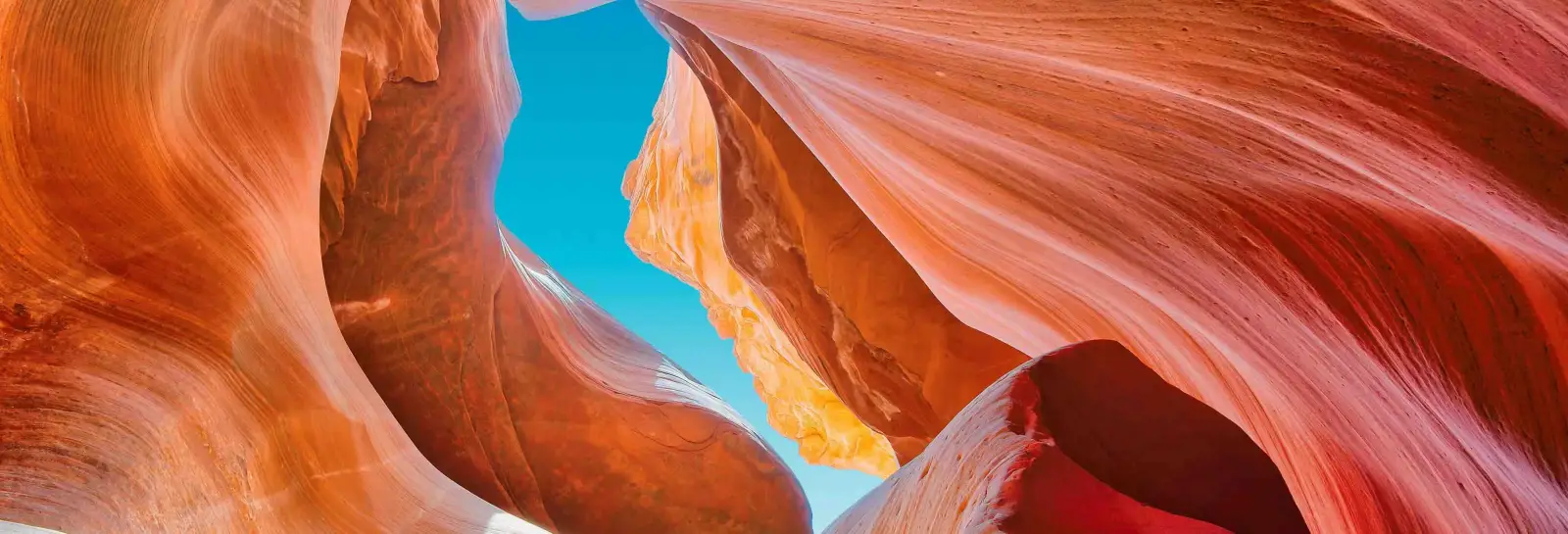
How Antelope Canyon Was Formed
Antelope Canyon is a slot canyon shaped primarily by fast-moving water, not wind. Over time, flash floods carved narrow corridors through Navajo sandstone, smoothing the walls and creating the flowing, wave-like forms seen today. This page explains the geology behind the canyon’s shape and why the same forces that formed it still influence safety and tour operations.
The Short Answer: Water Did the Work
Antelope Canyon is a classic slot canyon carved mainly by fast-moving water. Flash floods cut narrow corridors through Navajo sandstone, polishing the walls and creating the flowing shapes seen today.
Flash Floods & Runoff
During storms, runoff can rush into the canyon and concentrate into powerful flows. Over time, repeated flood events scoured the channel, removed loose sand, and deepened the slot.
Navajo Sandstone
Antelope Canyon is carved into Navajo sandstone—a rock formed from ancient sand dunes that later hardened. Natural fractures and weaker layers gave floodwater paths to widen and smooth.
Time + Repetition
The canyon’s shape wasn’t created by one storm. Thousands of floods over long time scales gradually carved deeper passages and refined the wave-like walls.
Because the canyon forms through floodwater, weather still matters today. If conditions change, tours may pause for safety—see the Antelope Canyon Weather Guide.
Step-by-Step: From Sandstone to Slot Canyon
Antelope Canyon did not appear fully formed. It developed through a sequence of geological processes that gradually transformed solid sandstone into a narrow slot canyon.
- 1. Ancient Sand Dunes Formed. Wind-blown desert dunes compacted and cemented into Navajo sandstone.
- 2. Rock Layers Fractured. Natural cracks created weak points in the sandstone.
- 3. Storm Runoff Concentrated. Rainfall from surrounding high ground funneled into these cracks.
- 4. Flash Floods Eroded the Channel. Fast-moving water carried sand and debris, grinding and deepening the passage.
- 5. Repetition Refined the Shape. Over thousands of years, repeated floods smoothed walls and carved flowing curves.
Why the Walls Are So Smooth
Floodwater does more than remove rock—it carries sand and sediment that act like natural sandpaper. As water rushes through narrow channels, it swirls and grinds against the sandstone, rounding sharp edges and polishing surfaces.
The result is the canyon’s signature appearance: curved walls, dramatic light patterns, and narrow corridors that twist with the path of ancient floodwater.
Why the Walls Look Like Waves
The flowing patterns inside Antelope Canyon are not random. They reflect how ancient sand dunes were preserved in stone and later shaped by water erosion.
Cross-Bedding: Preserved Sand Dunes
Navajo sandstone formed from massive desert dunes millions of years ago. As wind shifted dunes, angled layers of sand accumulated. When these dunes hardened into rock, the angled layers remained visible as cross-bedding—the sweeping diagonal lines you see on canyon walls.
Differential Erosion: Some Layers Wear Faster
Not all sandstone layers are equally resistant. Softer or more fractured sections erode more quickly, while harder layers resist. This process, called differential erosion, creates grooves, curves, and the signature wave-like texture.
Swirling Floodwater Shapes the Curves
As floodwater rushes through narrow passages, it accelerates and forms rotating currents. These swirling motions grind against the rock, smoothing edges and sculpting rounded forms. The tighter the passage, the more focused the erosion.
Flash Floods: Formation and Risk Are Linked
The same powerful floodwater that carved Antelope Canyon over thousands of years can still pose risks today. Understanding this connection explains why access is carefully managed.
How Floods Shape the Canyon
When heavy rain falls on higher ground surrounding the canyon, water funnels into narrow channels. Because slot canyons are confined spaces, water can accelerate quickly, carrying sand and debris that continue to erode and polish the rock.
Even though large carving events are rare today, seasonal runoff still subtly modifies the canyon’s surfaces.
Why Tours May Pause
Slot canyons can flood even when skies above appear clear. Rainfall miles away can send sudden runoff downstream. Because corridors are narrow and vertical, there are limited escape routes once water enters.
For this reason, tour operations may pause during monsoon activity or unstable weather conditions. These precautions are part of modern canyon management.
Seasonal conditions matter. See the Antelope Canyon Weather Guide for month-by-month patterns and monsoon details.
Does Formation Differ Between Upper, Lower, and Canyon X?
These canyons share the same Navajo sandstone geology, but differences in canyon shape, depth, and opening width influence lighting, airflow, and the overall feel of the experience.
What’s the Same
- All are carved primarily by water erosion and flash-flood runoff.
- All cut through Navajo sandstone with visible cross-bedding layers.
- All are narrow slot canyons where corridor shape controls light and movement.
- All require guided access and can be affected by weather-related safety closures.
What Feels Different
- Opening width: wider openings allow more ambient light; narrower openings create stronger contrast.
- Depth & shape: deeper or more curved sections amplify reflected color and shadow patterns.
- Terrain: steps, ladders, and corridor tightness change how you move through the canyon.
- Timing: some sections are more sensitive to time-of-day lighting conditions than others.
Want a practical, visitor-focused breakdown (light, terrain, and who each canyon is best for)? See Upper vs Lower vs Canyon X.