Antelope Canyon Tours

Why Light Behaves Differently in Upper, Lower, and Antelope Canyon X

Although formed from the same Navajo sandstone, differences in canyon structure cause light to enter, reflect, and fade in very different ways.

Light inside Antelope Canyon is shaped less by location and more by structure. Canyon height, opening geometry, and route orientation determine whether light appears as focused beams, soft reflections, or high-contrast shadows.

Upper Antelope Canyon has narrow, relatively straight openings that allow sunlight to enter at steep angles during specific times of the year. This creates the well-known vertical light beams and results in lighting that is more repeatable and controlled along the flat, guided route.

Lower Antelope Canyon follows a winding, spiral-like path with openings that vary in width and direction. Sunlight scatters and reflects off the walls, producing softer illumination that highlights color transitions, textures, and a stronger sense of depth rather than defined beams.

Antelope Canyon X features wider openings and multiple chambers oriented in different directions. Light enters more freely but less predictably, creating dramatic contrasts between light and shadow. Its lighting is less dependent on a narrow seasonal window, but also less controlled moment to moment.

In all three canyons, lighting is not simply about “having light beams or not.” It is the combined effect of canyon shape, opening geometry, and route design that defines how light moves and how the experience ultimately feels.
How Terrain Shapes Movement, Pace, and Immersion

The physical layout of each canyon directly influences how visitors move, pause, and experience the space around them.

Upper Antelope Canyon

A flat, ground-level route allows visitors to move smoothly without physical interruption. Stops are frequent but brief, often coordinated around lighting moments, creating a steady rhythm with minimal physical effort.

Lower Antelope Canyon

Stairs, ladders, and elevation changes break movement into segments. The constant shift between climbing, descending, and navigating tight turns makes the experience feel more active and physically engaging.

Antelope Canyon X

Wider passages and longer walking stretches encourage a slower, more continuous pace. Visitors tend to move more freely, with fewer forced stops, allowing for extended moments of observation and exploration.

While all three canyons are guided experiences, their terrain determines whether the visit feels staged, adventurous, or relaxed—often more than group size alone.

Crowds, Routes, and the Perception of Congestion

The feeling of “crowded” inside Antelope Canyon is shaped less by numbers and more by route design, pacing, and visual openness.

Upper Antelope Canyon

Visitor flow is tightly managed along a single, narrow corridor. Although group volume is high, movement is regulated and predictable, which often makes congestion feel controlled rather than chaotic.

Lower Antelope Canyon

The route includes turns, elevation changes, and ladder sections. Groups are naturally spaced out, but pauses tend to cluster at stairs, which can make crowding feel more physical and noticeable.

Antelope Canyon X

Wider passages and multiple chambers reduce visual compression. Even during busier periods, the canyon often feels more open, though peak seasons can narrow the gap compared to Upper and Lower.

Crowd experience is not only about how many people are inside, but how the canyon’s shape guides movement, sightlines, and stopping points.

Photography Differences: More Than Just Light Beams

Photography inside Antelope Canyon is shaped by light control, movement freedom, and how much time you can spend composing each shot.

Upper Antelope Canyon

Lighting moments are highly anticipated and time-dependent. Photo stops are brief and structured, with guides often directing attention toward specific beam locations rather than free exploration.

Lower Antelope Canyon

Shooting is more continuous as you move through the canyon. Changing elevations and angles create layered compositions, but frequent movement requires faster decision-making.

Antelope Canyon X

Wider chambers allow longer pauses and greater compositional freedom. Photographers can experiment with shadow, contrast, and framing without relying on a narrow lighting window.

The key difference is not whether dramatic light appears, but how much control you have over timing, angle, and attention. If none of these three feels like the right fit, see Antelope Canyon Alternatives for smaller canyon names near Page.

Common Misconceptions That Lead to the Wrong Choice

These statements are often repeated online, but they’re only true under specific conditions.

Misconception

Upper Antelope Canyon guarantees light beams on every visit.

Reality

Beams depend on season, sun angle, and timing. Even at midday, clouds and route timing can shift what you actually see inside.

When it’s true

In peak beam months during clear skies, the top opening geometry makes beams more likely and more “staged” than the other canyons.

Misconception

Lower is simply “more stairs,” but the experience is otherwise the same.

Reality

Lower’s below-ground feel and winding route change how you move, pause, and frame shots. It’s more continuous motion with changing angles and depth cues.

When it’s true

If your goal is only “slot canyon walls,” all three deliver sandstone textures—yet Lower’s pace and vertical transitions still make it distinct.

Misconception

Canyon X has no dramatic light because it’s not famous for beams.

Reality

Canyon X often delivers strong contrast, bright chambers, and shadow transitions. The “wow” is atmospheric light and open-space composition, not vertical shafts.

When it’s true

If your only target is classic beam shots, X is not the primary pick. If you want variety, calmer pacing, and less time-window dependence, it can outperform expectations.

Misconception

More visitors automatically means the canyon will feel overcrowded.

Reality

“Crowded” is shaped by route width, stop points, and flow control. A managed route can feel smoother than a smaller group in a pinch point.

When it’s true

At peak seasons and prime midday windows, all canyons tighten. The difference becomes how each route absorbs pauses and bottlenecks.

Misconception

Better gear is the main factor behind great Antelope Canyon photos.

Reality

Timing, light behavior, and how long you can stabilize and compose matter more. Phones can do surprisingly well when you understand exposure and movement constraints.

When it’s true

For low-light texture work and color fidelity, camera control helps—but the canyon’s tour flow and light profile still dominate the outcome.

Reference Comparison: Upper vs Lower vs Antelope Canyon X

A condition-based comparison focusing on terrain, structure, and operational constraints— not quick recommendations.

Dimension Upper Antelope Canyon Lower Antelope Canyon Antelope Canyon X
Canyon Position At ground level Below ground (slot canyon with stair descent) At ground level with open chambers
Access to Canyon Entrance Short off-road truck ride after check-in Walk directly from meeting point to entrance Short off-road truck ride after grouping
Route Flexibility Single-direction route since 2023, designed to
reduce congestion and improve flow consistency.
Fully one-way route with a separate entrance and
exit, maintaining continuous forward movement
throughout the tour.
Split into two main sections; each section is
explored separately, requiring a return along
the same path before entering the next area.
Seasonal Sensitivity High — light beams depend on season and sun angle Moderate — lighting stable, but weather-sensitive Low — experience less dependent on season
Flood Risk (Rainy Season) * Lower impact; closures possible but less frequent Higher risk due to below-ground terrain, especially Jun–Sep Lower impact compared to Lower Canyon
Time-of-Day Dependency Very high — midday windows matter most Low — visual experience spread across the day Low to moderate — varies by chamber orientation
Tour Control Level High — tightly timed and choreographed Moderate — guided but movement-driven Lower — looser pacing and spacing
Perceived Crowding Often feels controlled despite volume Feels tighter due to stairs and narrow turns Feels more open; differences narrow in peak season
Photography Constraints Strong light, limited stop time Lower light, more angle discovery Diffuse light, higher compositional freedom

Combining Multiple Antelope Canyon Visits

Visiting more than one canyon in a single day is possible with proper timing and realistic expectations.

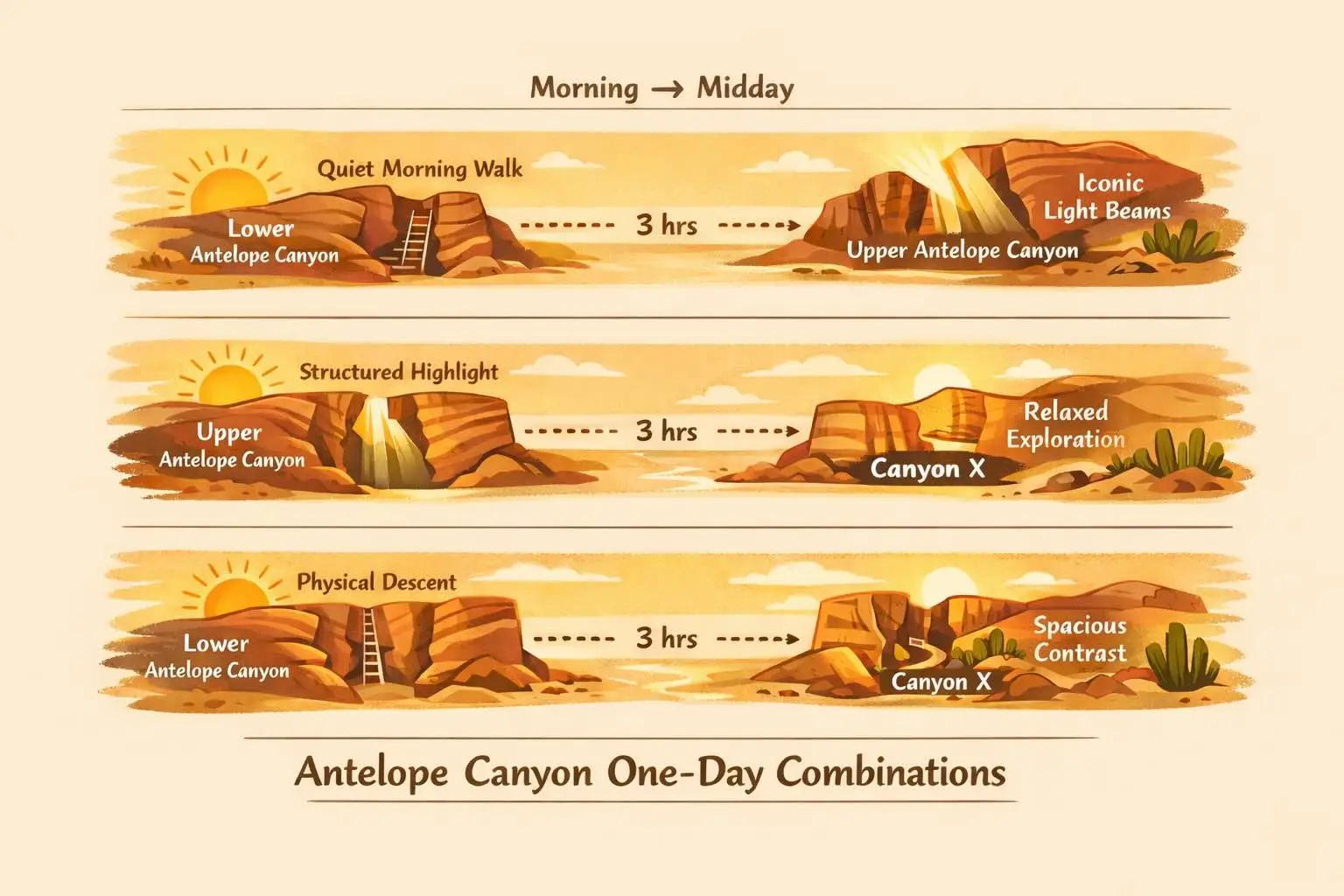
Antelope Canyon one-day tour combinations showing Upper, Lower, and Canyon X visit sequences with recommended 3-hour intervals
Common one-day combinations for visiting Upper Antelope Canyon, Lower Antelope Canyon, and Canyon X, with recommended spacing between tours.

When planning to visit both Upper and Lower Antelope Canyon on the same day, allow a minimum of three hours between tour start times. This buffer accounts for strict check-in requirements, travel between meeting points, and natural variation in tour pacing.

A common and effective approach is to visit Lower Antelope Canyon in the early morning, when crowds are lighter and temperatures are cooler, followed by an Upper Antelope Canyon tour around midday to experience the iconic light beams. Another popular combination is Upper Antelope Canyon at midday paired with Antelope Canyon X in the afternoon, which offers more flexible timing and a calmer pace.

Lower Antelope Canyon can also be combined with Antelope Canyon X, typically by scheduling Lower in the morning and Canyon X later in the day. This pairing balances physical effort with a more relaxed second visit.

While a single canyon visit is enough to experience a classic slot canyon, each Antelope Canyon offers a distinct character. For travelers making a rare trip to Page, combining two canyons—when planned carefully—can provide a broader and more memorable perspective on the region’s varied sandstone landscapes.

Antelope Canyon Tours is a trusted travel resource and booking platform for Antelope Canyon and the Page, Arizona area. We offer real-time availability and secure booking for Upper Antelope Canyon, Lower Antelope Canyon, and Antelope Canyon X tours operated by officially authorized Navajo guides, plus essential travel guides to help you plan with confidence.

Email Us
Chat Now